This year, the bluebonnets feel like distractions— a velvet curtain pulled over something beginning to fray.
In the rearview, she hums with Billie Eilish in her headphones, her face still round with youth, but beginning to learn its angles.
I worry. A queer kid in public school, growing up in a state that tilts harder with each new bill.
While those at the top swing hammers at federal protections, local extremists finally see their opening.
She catches me watching. I smile, because she makes me proud— and because that’s the role I’ve been handed: polishing a mask of promise for a future I no longer trust.
Inside, I’m taking notes, tracking exits, wondering how fast the country I once fought for can forget what it promised.
I used to believe in the swing, that the arc bends back, that cruelty burns itself out. Now I’m not so sure. It feels like we’re circling a drain, waving Bibles, burning books, hiding hate beneath the language of—
She laughs at something I can’t hear. The sound slices clean through the noise, bright and real and perfect in a field already fading.
Hi, friends! I haven’t posted much lately because I’ve been busy editing a poetry chapbook that just dropped a few days ago: Record of Dissent: Poems of Protest in an Authoritarian Age. You can read or download the full collection over at The Chaos Section Poetry Project.
This poem didn’t make it into the chapbook, but it’s cut from the same cloth. I wrote it a few months ago, driving back into the Texas Hill Country with my daughter after visiting family in New Mexico. We traversed the Edwards Plateau, then dropped into the Hill Country, where Austin sprawled ahead. The bluebonnets were blooming and the fields were beautiful, but my mind was elsewhere.
I’d just read an article about anti-LGBTQ legislation targeting public schools here in Texas—can’t even remember which bill, honestly. Around that same time, I saw another headline about the Trump administration’s proposed budget cuts that would eliminate funding for the LGBTQ youth suicide prevention hotline. I ended up writing an essay about those cuts, which ran in HuffPost. You can read it here if you’re interested.
Hey friends and fellow poets! Just a quick note. I’ve been helping set up a new poetry site, The Chaos Section Poetry Project, and we’re currently looking for submissions. The theme is anti-authoritarianism—mostly U.S.-focused, but open to global perspectives too. No payment, just a space for poems that speak to the moment. I know the focus is pretty specific and I don’t want to assume anyone’s politics, but if it resonates with you, feel free to check it out below:
Name a thing, and it unravels the moment you speak. Meaning flickers, hushed at the edge of every breath. At dawn, a crow-black thread stretches across pale sky, some echo of a verse, wingstroke-torn, drifting beyond reach. Once, the horizon was only rumor, slipping across half-remembered roads; now it gathers our scattered thoughts like coins in a jar. We’ve always sensed the caves within, the rolling brine of secret devotions, each one shifting in time, like a dusk-glow dissolving just beyond the borders of dream. I assume there is music hidden in the silence, a quiet chord waiting to unfurl when the last word fades.
This poem was first published in Eunoia Review on April 8th, 2025. I am grateful to the editors for featuring my work.
Fluffy pink unicorns dance on rainbows while long-lashed dogs wear flowers like fur. Soft green Yoda-lights sway overhead, framing my second-story window where moonlight spills onto the bed, silver-casting quiet shadows.
I drift, carried across a calm sea of sleep.
At dawn, I wake in a brighter room— its sharp light hums like a secret. A blue shark swims across a storm-tossed whiteboard before the bed floats gently down a river of tile.
Magic doors open, a deep breath, and then—nothing. Quieter than dreams, deeper than memory.
When I surface again, the curtains sway, soft as whispers, their patterns slip through the mind-haze. Family waits, voices steady, smiling as I slowly return to my body.
A kind nurse guides me to the chair. Its wheels sing toward the elevator, to the car, and then,
Home.
Whole again, though I never truly fell apart.
Note: This poem was first published in Issue 3 of Poems for Tomorrow, a poetry and art journal that shares creative work with patients in hospitals and care facilities. Their mission is simple and good: to help people feel connected, loved, and heard during hard moments. They put together anthologies of poems and art that are placed in hospital waiting rooms, senior centers, and long-term care units—places where a little beauty can go a long way.
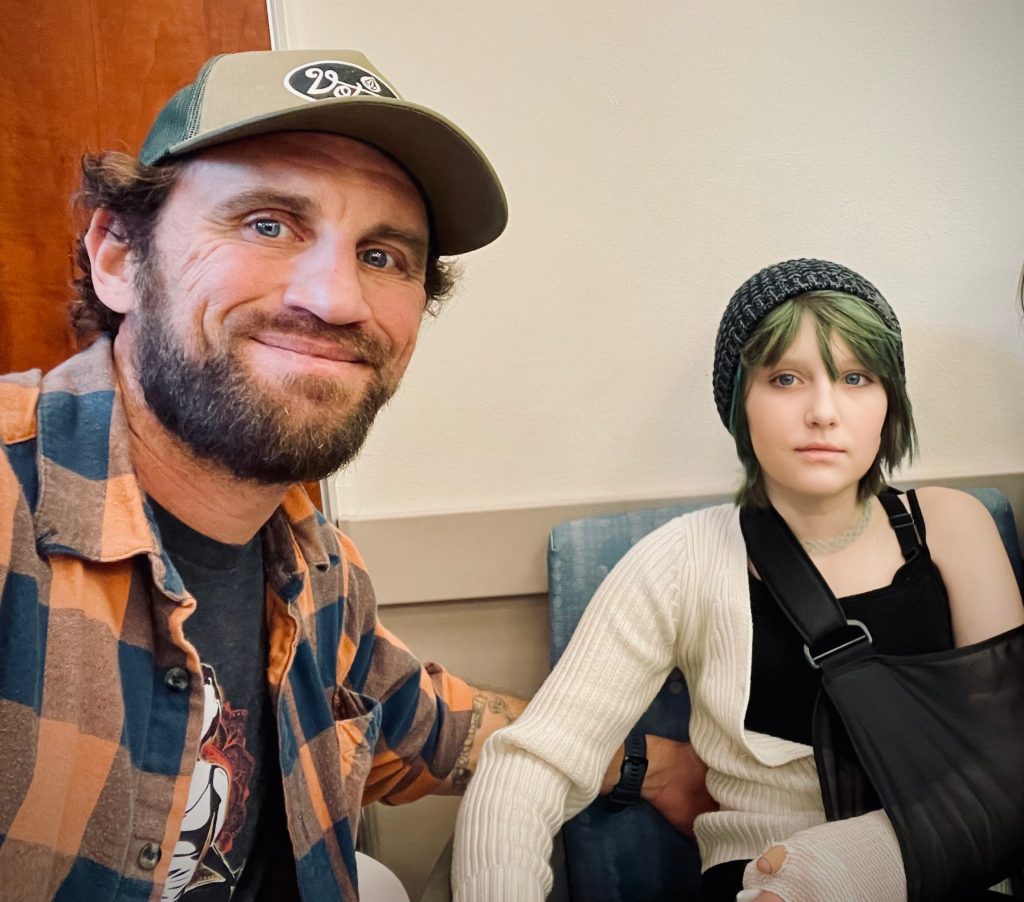
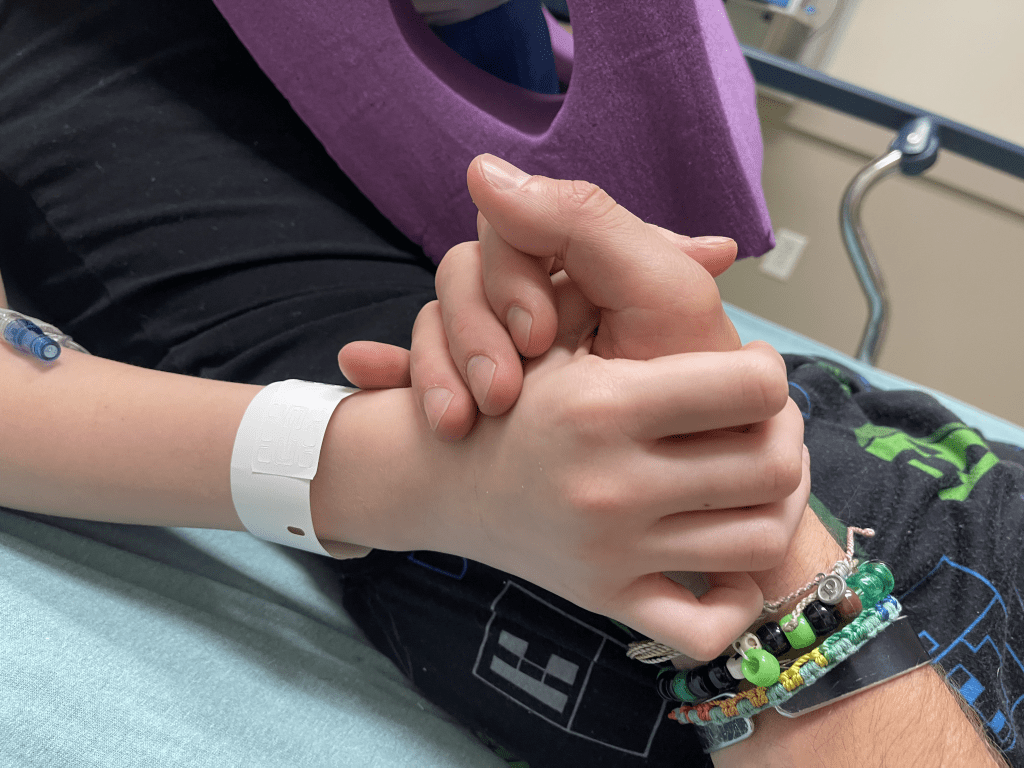
“Magic Doors” is a chain poem co-written, line for line, with my 11-year-old daughter, Phoebe, during the days surrounding her surgery to repair a severe double fracture in her left forearm. Both the radius and ulna were shattered, and the repair required rods and a full-arm cast. The poem tells her story through the eyes of three rooms: her bedroom the night before, the pre-op room, and the recovery room. It’s about resilience, imagination, and the strange kind of magic that shows up when you’re stuck in a hospital and still trying to feel like yourself. She’s an amazing, kind, empathetic, and creative kid, and I couldn’t be more proud of her.
They also published Phoebe’s original painting, Stargazing Cat on a Beach at Midnight—an acrylic-on-canvas piece she made for her grandfather while he was in the hospital recovering from throat cancer surgery.
She’s never been one for weighty words, but her expressions shine through with clarity, a language I’ve learned to read across the room.
Her smile sketches the degrees of joy, her shoulders measure the weight of weariness, her touch—a whisper of empathy. And her eyes—eyes that reflect all the ways blue can be— mirror shifting moods, fleeting thoughts, the quiet undercurrents of her heart.
A brief window into the storms and still waters within.
The yew leans into her thousand years, while the moon moth burns swiftly through a handful of days. Eight decades feel fair, if spent well, we tell ourselves.
Antares yawns across another eon and winks at Sirius, grown weary of our fragile math and wistful speculation.
The newborn winter sky, driftwood-gray and heavy with mist, fosters a strange kind of contentment— a feeling that brushes the edge of melancholy yet never settles there.
To call this weather bad feels like a failure of perspective. It simply is. So I lean into it, letting it press somewhere beneath my ribcage.
The porcelain mug contrasts with mud-brown coffee; its aroma mingles softly with incense and muted conversation.
Heat trembles at the surface— molecules gather courage to rise into air, a quiet departure joining the endless cycle: dissolution, reformation, death folding into rebirth.
I suspect, secretly, we know how they feel, or at least long to.
As I raise the warm cup, a homeless man shuffles by, tattered blankets trailing through frosty puddles. His sudden, hollow presence pulls at the edges of my fragile equanimity.
I wonder if guilt can exist without responsibility, or if responsibility, however delegated or denied, lurks in the quiet corners of our collective comfort.
I thought of you then, in those days of forgetting, your eyes stealing from the moon, dagger-deep but drawn with fatigue. The phantoms of time promise plans too lofty to keep.
Another New Year’s Eve has arrived. The weather couldn’t have been better—65 degrees and sunny, with a light north wind. I spent the day visiting the Austin Zen Center, taking a walk along Lady Bird Lake, and enjoying a cup of coffee at Civil Goat on Guadalupe, where I wrote this short poem.
Thank you to everyone who has taken the time to read or comment this past year—and even more so, thank you for all the incredible poetry you’ve shared. Y’all are the best. It’s awesome to have a group of such talented, inspiring friends—that I’ve never actually met.
Wishing you all a safe, happy, and peaceful new year.
– Nick
Make Friends with the Fallen Leaves
A quiet door opens, as another closes. The last breath of the year feels much like the first.
This next revolution greeted with mindful gratitude, an earth-bound walk. When feet brush the path, it sounds like surrender.
A song shared with a winter bird, a nod passed to a stranger— just for a moment, before momentum carries forward.
We smile, pay our respects to impermanence. And make friends with the fallen leaves.
A creeping meanness claws across the decade, no longer content to linger at the margins, teeth gnawing the hairline supports that once held courtesy in place.
Soft civility drowns— its gentle pleas severed against the razor-brink of thin bluster, each utterance a bright blade winking beneath the footlights.
Palm-sized portals grant absolution— thumb-swiped loops spinning like small, devouring storms. A sweetness laced in venom nourishes hollow appetites.
Not my problem— the call rebounds through the hollow chambers of power, where anger curdles under polished lids, served in delicate portions to tongues eager for the new flavor of spite.
This novel vintage pours freely, its aftertaste both repulsive and strangely comforting, as we sip and pretend not to notice.
I see myself in the old woman at the next table in the café. Her face carved with worry and wisdom, her hand quivers as she stirs her coffee.
I see myself in the angry teen at the bus stop, his daily journey to anxiety. Oily skin branded with acne and angst, a crossroads of ambition and uncertainty.
I see myself in the young mother, cradling an infant in her protective embrace. A fierce sentinel, a boundless love, a longing to nurture and shield.
I see myself in the soft cheeks of that child nestled safely in his mother’s arms. A bundle of promise, feeling only raw emotion, a life anchored in the present.
I see myself in the homeless veteran, body marred by war, soul weighted with sorrow. A tin cup, a cardboard sign, a quiet plea, pressing onward toward another sunrise.
I see myself in the prostitute, existence narrowed to a series of scores. Track-marked arms, and willing smile betrayed by eyes of deep despair.
I see myself in you— for I am you, and you are I. Divided by time, shaped by fate, alone, yet entwined in our brief existence, woven by the thread of our shared humanity.
This poem, I See Myself, was first published by Spillwords Press on December 6th, 2024. I am grateful to the editors for featuring my work.
For a moment, I considered change— a flicker of curiosity pressed against my borders.
But the tired two-step is easier than learning a new waltz. Five decades have taught me to hold familiar hands, to hum old songs in a voice steady with habit.
We build walls around ideas here. I’ve heard the whispers, felt their pull— something loose, unformed, waiting to take shape.
Maybe someday. But for now, I keep spinning, tracing the same worn paces, letting the dust settle where it always has.
This poem first appeared in Texas Poetry Assignment, Issue # 78, “Texas Speaks.” Many thanks to Laurence Musgrove for his acceptance and encouragement. I highly recommend exploring his works, especially The Bluebonnet Sutras, available here. Don’t miss the remarkable poets featured at Texas Poetry Assignment.
The sky bends beneath city lights, its vast quiet fractured— and yet the hunter emerges, sharp-edged, unbroken.
Once, he anchored me— half a world away, etched into desert winds, his watchful eyes a tether to what I could not hold: home, family, something unnamed.
Time slips, soft as owl’s breath, years folding into shadows, a presence felt, unseen, somewhere at the mind’s edge, like a promise carved in starlight.
But tonight, I look up; his belt gleams bright, as if memory itself has taken shape in the dark, steady, silent, unchanging.
You come from a long line of survivors— evident in the fact of your existence. Your kin endured famine’s grasp, wars beneath silent stars, and quakes that fractured the earth.
They braved fire’s fury, floodwaters that swallowed the land, scorching droughts, and ages of ice. They faced monsters in the dark, plagues that swept through nations, passing an enduring spirit forward— until you emerged.
Now you stand in uncertain times, fearful, yes, but forged by the fires of endurance, woven by hands that never yielded. Your breath is a hymn to resilience. Stand firm—not because it is easy, but because this is what you are made for.