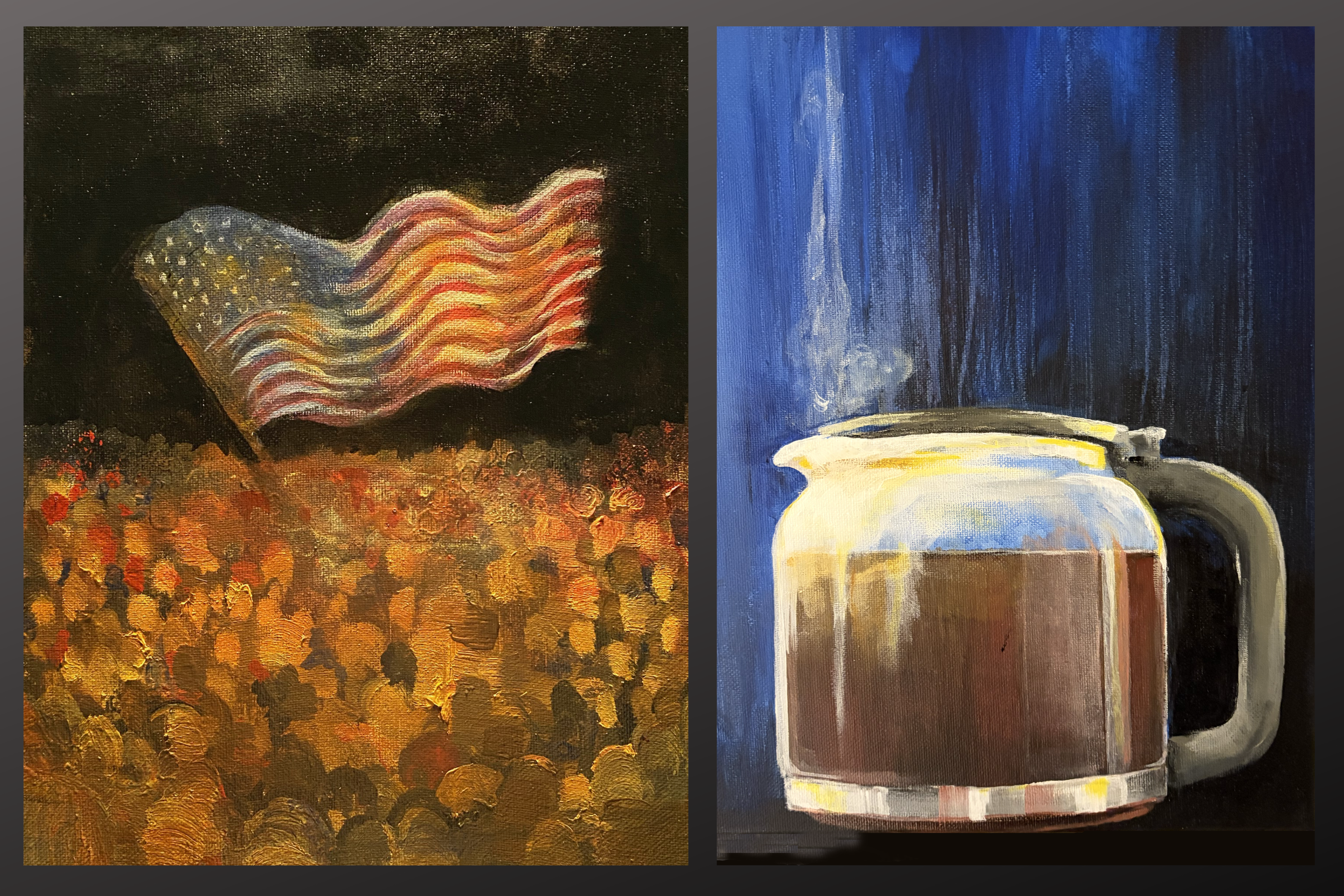
If I let myself go— not just falter, but fall— I lose the trail back from the sorrow of strangers, absorb the newsprint weight of grief until it settles in my marrow like winter.
The lines drawn in blood blur easily— becoming this mother, and the father across the river.
To feel what the world keeps behind glass is to glimpse something unspoken, something real.
Not evil, exactly. Maybe wrongness. A hollow in the hive-mind where reason should live— the inheritance of lazy thinking and sun-faded flags.
This old game? Yes, we’re still playing, though no one remembers to keep the score.
And I can choose to carry the cost, or set it down— to look away, like we do with so much else.
For now, I’ll stay a while—keep vigil in that hollow room built for one, but known by all, eventually.
I suppose I owe at least a breath of attention, the small price of saltwater and silence— to follow the trail, step into the slow-dark hush of grief that isn’t mine—
There was a time, a million years ago, when I believed art held some unique truth— a breath beneath color.
I angled paintbrushes toward the sky like telescopes, searched headlines through a camera lens, stood invisible on street corners with a ghost-hungry journal.
But then winter arrived and I called off the search—abrupt. Like the last shot fired in a clean, well-lighted place.
What truths can you find in five short years of stick-figure drawings and sloppy finger paint?
After I dropped the last shovel, I briefly dug for meaning beneath desert dogma, but the ground split too wide for a mind broken but still skeptical— too stubborn for feel-good bullshit or vague deity threats.
Once, I took a poetry class with a teacher who meant well. She was kind. Talented. But when she said, To be a good writer, you sit at the computer and bleed, my eyes rolled so far back I saw the past.
Me—alone in a room of books, loving Hemingway the most.
If you’re going to modernize a stolen quote, at least credit the dead man who suffered it first.
Not that I’m above theft. For a decade, I wore a borrowed smile, stretched over my face like cheap fabric, just to dodge that empty concern, Are you okay?— a dumb question with an easy answer I learned the old-fashioned way.
Eventually, the smile became my own. And maybe there was truth to be found somewhere— but I’m not going to tell you about that.
Because even if clichés sometimes crack open the dark, you wouldn’t want to see them here.
I probably lied to her when she asked about the future of her world— what else can you do when a young child pictures fields of fire, fueled by the fossils we burn, hands clutching rifles tighter than reason, the quiet neglect of those left shivering on street corners?
I see the same— though I wish I didn’t. So instead, I whispered of hope— hope in her generation, better than ours, believing they can mend the mess we leave behind.
A parent never wants to see fear reflected in their child’s eyes— or worse, the slow dimming of belief that things will get better.
What I don’t see— not yet at least— is disappointment. But it will come, with age and understanding, with eyes that once gazed hopefully at the future, now looking back to me for answers—
because I am the goddamn adult here, and I should know how to fix everything.
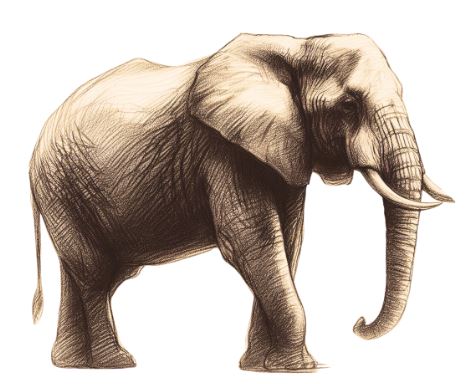
The topic that chose me this morning was African Elephants. Unbidden, they came from depths unknown.
I did not plan to ponder Elephants, and I certainly didn’t intend to write about them.
Yet here they are, grand, gray, glorious, trumpeting and trampling through my thoughts, pushing aside other ideas, and knocking over the carefully arranged furniture,
generally making a mess of the place, as one might expect of such titans trapped within the mind’s limited landscape.
So here I sit, at the keyboard and computer, an ethereal door to the digital wilderness, open wide, inviting them to wander into the vast wilds whence they came.
Elephant Parade was published in Kindred Characters Literary Magazine (Lark & Owl Booksellers), Issue 2, Winter 2025, available now at Lark and Owl in Georgetown, TX.
I was up before the squirrels this morning, before the sun, too. On the front porch, all is quiet, the way early mornings tend to be.
In cupped hands I catch a moment that refuses to be counted, steady enough to cradle, gentle enough to release what isn’t mine to keep.
A butterfly teases a northwest breeze, a tethered promise of flannel and fleece. Its wings catch the first light, red softening to orange, black to something more than gray.
I think again about numbers— about days, months, years— each lived alone, each carrying its own weight, boxed inside borders we draw.
From a distance they slip into a current, slow at first, then less so.
The first squirrel gives in to gravity, drops, gathers acorns meant for the earth, then retreats into late-summer leaves, off to do whatever squirrels do.
This poem was first published at MasticadoresUSA. Thanks you, Barbara!
Just make it simple, I tell myself, and say thank God you’re not a therapist.
I am lighter for my foot bath and ready—ready for a new me, garnished with exotic island melodies, coating me with love no longer here, but becoming the very first, stable platform for the rebuild…
Ready for what’s next.
In saying goodbye, whatever the age, did you know it’s alright to wonder, the way ladybugs often do?
Will you come with me towards bright beautiful flight, before landing just right, like insects in my belly?
Paradise is sanctuary if it keeps your hands from shaking, and foulness where it shouldn’t be.
My sweet child and I sit crowned by persistence. I believe in me, where I was birthed, how to hold you again.
Trying to change my view ‘til I’m resting in somebody’s arms, but finding my way home through the rain fragrant, alluring—but jaggedly thorned, my gaze fixed in the perfect spill of stars.
And in their imperfections, I rise.
Feral cat jumps from the wood pile for all of us— unfurl, veins of my freedom, prepare to love and finally to live, live life to the full—stop—
Does any of that sound like consumerism to you? United We Stand, yet unable to thrive. I love you more, at least on the outside.
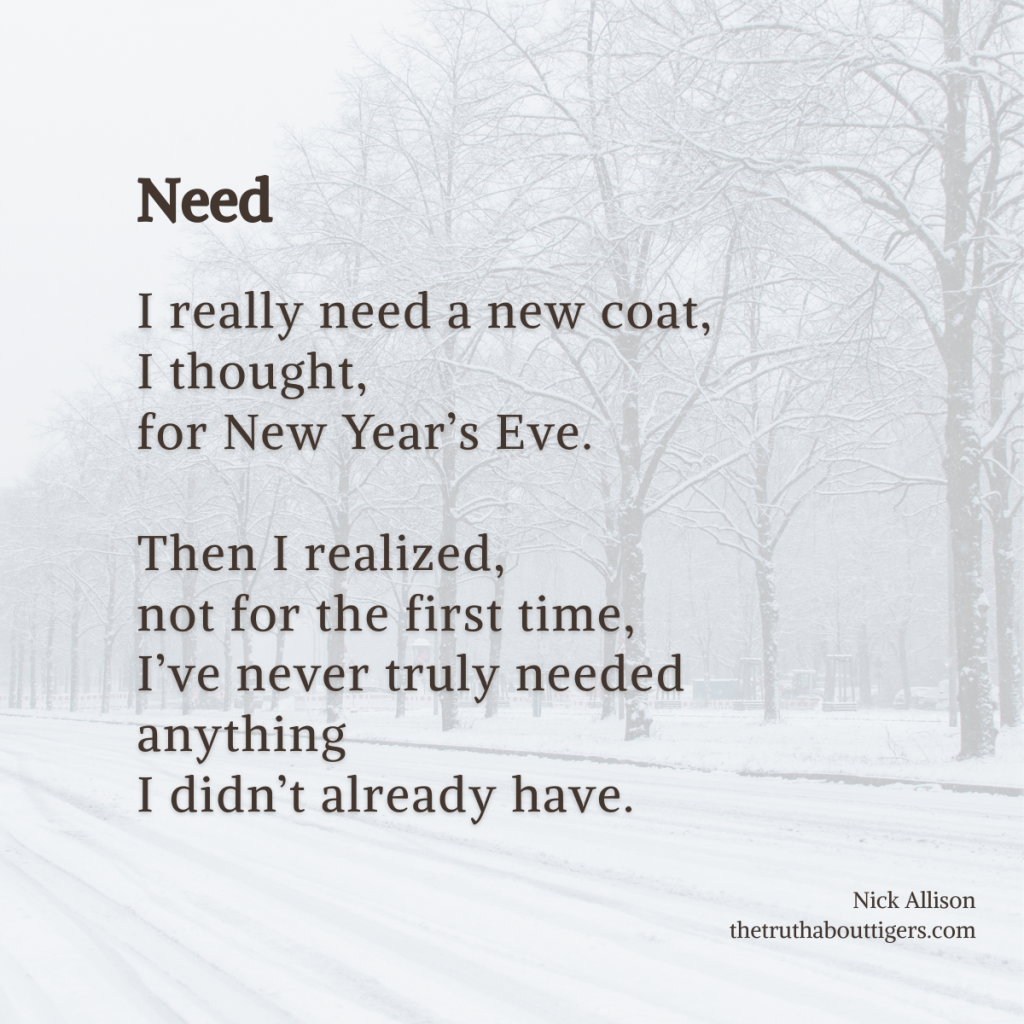
No cliché ever held more truth.
The nerves have long stretched outwards from my spine, and though the illness lingers, so do I, high above it all.
It is every baby’s laugh, with real life left for living in between, a quiet door to a peace that isn’t a crime, and always the last forever.
Slowly I come back into my body and the hope that the tape in this tiny drawer will be enough.
I took down the sparkle-lines tonight and sung in an age of captivity, here now, here now, here now….
Beauty has come to this world, where nothing holds, and nothing has to.
The poem was inspired by a cento created by contributor Melissa Lemay, who recently assembled a poem using the first lines of each poem in the same book. Seeing those openings gathered together made me curious about the other end of the book, about what remained after each poem finished speaking.
I think it actually works surprisingly well!
– Nick Allison
The original lines in this poem were written by the following contributors (listed here alphabetically, not in the order in which their lines appear): Meridith Allison, Nick Allison, Rachel Armes-McLaughlin, Brent Boeckman, Kate Bremer, Paul Cannon, R.M. Carlson, Zsófia Hajnal, Sam Hendrian, Audrey Howitt, Carol Anne Johnson, Erica Johnson, Frank Johnson, Melissa Lemay, Barbara Harris Leonhard, Isabelle Luebke, Sue McBean, Luke Meyers, Aubrey Phoenix, Kerfe Roig, Nicole Sara, Phoebe Shade, Merril D. Smith, Edward St. James, Joshua Walker, Eileen ‘ike’ West, Kim Whysall-Hammond, Meghan Woodward.
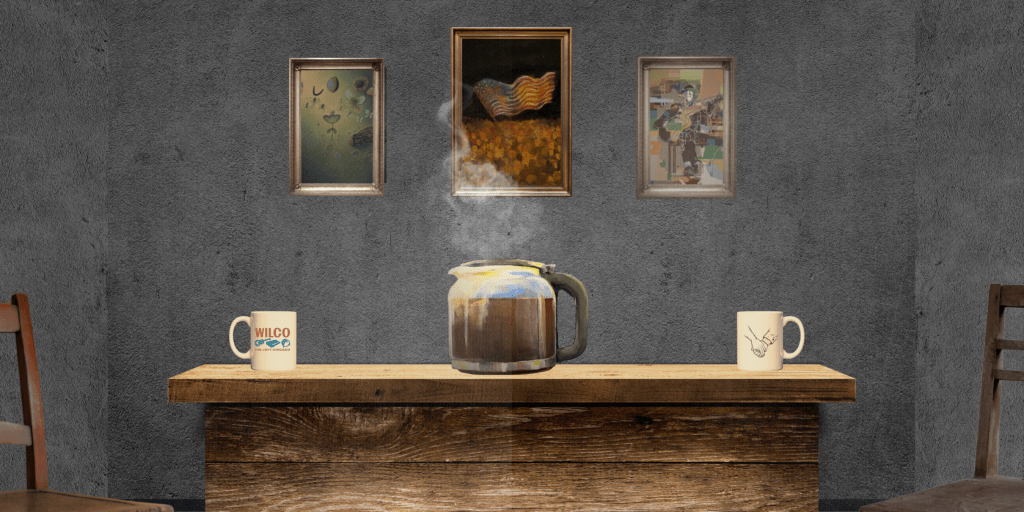
The accompanying digital collage was created using elements from What We Hold On To, incorporating Bonner Fowles’ original cover artwork, with visual references to interior illustrations by Phoebe Shade and Isabelle Luebke, and to the epigraph voices of Jeff Tweedy, Leonard Cohen, and Wendell Berry. It also pays tribute to our first published collection, Record of Dissent.
Cento — Poetry Foundation From the Latin word for “patchwork garment,” a cento is a literary work collaged entirely from other authors’ verses or passages. In their earliest forms, centos were often composed as tribute, such as those by Byzantine empress Eudocia Augusta, which paid homage to Homer. Centos had a resurgence in popularity with the rise of collage as a compositional device among Modernist writers.
I hadn’t planned a party, not for this unremarkable milestone that falls somewhere past the midpoint of an average human lifespan.
Then a birthday message arrived, linking January 30th’s famed celebrants, and before I knew it they were all here, gathered around a long table in my mind.
Dick Cheney and Saul Alinsky locked in argument, Franklin Roosevelt trying, as always, to keep the peace.
Across from them, the actors hold court, Gene Hackman and Christian Bale debating the finer points of American hustles and French connections, their voices competing with Phil Collins— oh lord—tapping jazz rhythms with chopsticks on red Solo cups, Roy Eldridge chiming in on a plastic party kazoo.
Amid the imagined chaos, I think about these collective sunrises, the meaning we give to coincidence where none exists.
Still, it was pretty great when Richard Brautigan finally showed up, handing out homemade cards printed with his strange, gentle lines from Trout Fishing in America, a book I love but probably still don’t completely understand:
All of us have a place in history. Mine is clouds.
Acorns pelt the ground, littering the lawn. She calls them small prophets, warning of the cold to come, though I suspect the trees only speak of the past.
I once pursued a degree in philosophy but didn’t finish, which, in hindsight, might’ve been the most philosophical decision I ever made.
The syllabus read like a price tag on secondhand wisdom, enough zeros to prop up a small island economy.
Somewhere between Aristotle’s ethics and a lecture on infinite regress, I started to wonder how anyone gets past the Cynics without questioning why we’re paying tuition to master the art of uncertainty—
a credential that mostly qualifies you to explain determinism to a coworker on a smoke break while your wages barely cover the cost of survival.
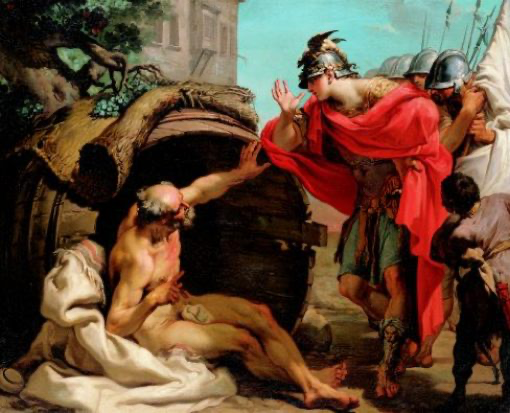
By then it seemed obvious— a better choice might be living naked in a barrel, lobbing a few well-placed insults, and telling the occasional king to get out of your light.
Gaetano Gandolfi, Alexander and Diogenes (c. 1792).
Hi, friends. I wanted to share a few Collaborature updates in one place. Editor Melissa Lemay featured Mad Dark Winter Sky, a short poem my daughter Phoebe and I wrote together a few years ago when she was nine. We made it using those little word magnets you can rearrange on the refrigerator to form sentences.
Melissa also invited me to serve as the guest judge for the November contest—something I was admittedly nervous about and felt under-qualified for. But, being the wonderful human she is, Melissa put me at ease and reminded me that the guest judge simply chooses the poem that resonates most. In the end, I went with the one that jumped out to me first and stayed with me the longest. Congratulations to Chiwenite Onyekwelu for the winning poem, The Carpenter at St. Ignatius. There’s also a brief “meet the judge” introduction if you’re interested.
Collaborature is a collaborative literary space built around honesty, creativity, and community, and it’s well worth checking out.
Some numbers are just too big for the human brain to fully comprehend:
a septillion stars, two trillion galaxies, seven billion people, thirty-six percent
of Americans who somehow still look past the casual racism, the xenophobia, the creeping fascism flowing from the sleepy, unhinged man slumped at the Resolute desk.
To applaud a corpse is only arithmetic. Subtract the breath, add the headline, divide by tribe.
The flag gnaws its own threads, spits the blue space between stars into the gutter as wingbeats of lead scribble their errata across the sky.
Again we mistake fire for gospel, map for tinder. Every throat a fusebox, every ballot a feather that floats toward an open furnace.
Danger lives in the gray fracture, lurking behind a mask of slogans.
Is this the route we wish to take?
To march into fire believing it light, while cities fold into themselves like broken accordions?
When the sidewalks are salted with brass and steel even those who claim victory have already lost.
Nothing grows here but teeth.
A republic teaches itself to disappear by repeating the word them.
This poem was first published at Mobius: The Journal of Social Change and later nominated for a 2026 Pushcart Prize. Huge thanks to F. J. Bergmann and the Mobius team.