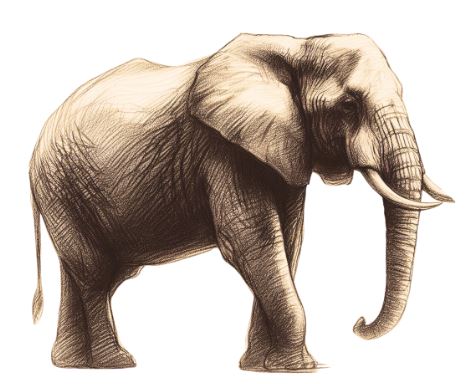
The topic that chose me this morning was African Elephants. Unbidden, they came from depths unknown.
I did not plan to ponder Elephants, and I certainly didn’t intend to write about them.
Yet here they are, grand, gray, glorious, trumpeting and trampling through my thoughts, pushing aside other ideas, and knocking over the carefully arranged furniture,
generally making a mess of the place, as one might expect of such titans trapped within the mind’s limited landscape.
So here I sit, at the keyboard and computer, an ethereal door to the digital wilderness, open wide, inviting them to wander into the vast wilds whence they came.
Elephant Parade was published in Kindred Characters Literary Magazine (Lark & Owl Booksellers), Issue 2, Winter 2025, available now at Lark and Owl in Georgetown, TX.
I was up before the squirrels this morning, before the sun, too. On the front porch, all is quiet, the way early mornings tend to be.
In cupped hands I catch a moment that refuses to be counted, steady enough to cradle, gentle enough to release what isn’t mine to keep.
A butterfly teases a northwest breeze, a tethered promise of flannel and fleece. Its wings catch the first light, red softening to orange, black to something more than gray.
I think again about numbers— about days, months, years— each lived alone, each carrying its own weight, boxed inside borders we draw.
From a distance they slip into a current, slow at first, then less so.
The first squirrel gives in to gravity, drops, gathers acorns meant for the earth, then retreats into late-summer leaves, off to do whatever squirrels do.
This poem was first published at MasticadoresUSA. Thanks you, Barbara!
Just make it simple, I tell myself, and say thank God you’re not a therapist.
I am lighter for my foot bath and ready—ready for a new me, garnished with exotic island melodies, coating me with love no longer here, but becoming the very first, stable platform for the rebuild…
Ready for what’s next.
In saying goodbye, whatever the age, did you know it’s alright to wonder, the way ladybugs often do?
Will you come with me towards bright beautiful flight, before landing just right, like insects in my belly?
Paradise is sanctuary if it keeps your hands from shaking, and foulness where it shouldn’t be.
My sweet child and I sit crowned by persistence. I believe in me, where I was birthed, how to hold you again.
Trying to change my view ‘til I’m resting in somebody’s arms, but finding my way home through the rain fragrant, alluring—but jaggedly thorned, my gaze fixed in the perfect spill of stars.
And in their imperfections, I rise.
Feral cat jumps from the wood pile for all of us— unfurl, veins of my freedom, prepare to love and finally to live, live life to the full—stop—
Does any of that sound like consumerism to you? United We Stand, yet unable to thrive. I love you more, at least on the outside.
No cliché ever held more truth.
The nerves have long stretched outwards from my spine, and though the illness lingers, so do I, high above it all.
It is every baby’s laugh, with real life left for living in between, a quiet door to a peace that isn’t a crime, and always the last forever.
Slowly I come back into my body and the hope that the tape in this tiny drawer will be enough.
I took down the sparkle-lines tonight and sung in an age of captivity, here now, here now, here now….
Beauty has come to this world, where nothing holds, and nothing has to.
The poem was inspired by a cento created by contributor Melissa Lemay, who recently assembled a poem using the first lines of each poem in the same book. Seeing those openings gathered together made me curious about the other end of the book, about what remained after each poem finished speaking.
I think it actually works surprisingly well!
– Nick Allison
The original lines in this poem were written by the following contributors (listed here alphabetically, not in the order in which their lines appear): Meridith Allison, Nick Allison, Rachel Armes-McLaughlin, Brent Boeckman, Kate Bremer, Paul Cannon, R.M. Carlson, Zsófia Hajnal, Sam Hendrian, Audrey Howitt, Carol Anne Johnson, Erica Johnson, Frank Johnson, Melissa Lemay, Barbara Harris Leonhard, Isabelle Luebke, Sue McBean, Luke Meyers, Aubrey Phoenix, Kerfe Roig, Nicole Sara, Phoebe Shade, Merril D. Smith, Edward St. James, Joshua Walker, Eileen ‘ike’ West, Kim Whysall-Hammond, Meghan Woodward.
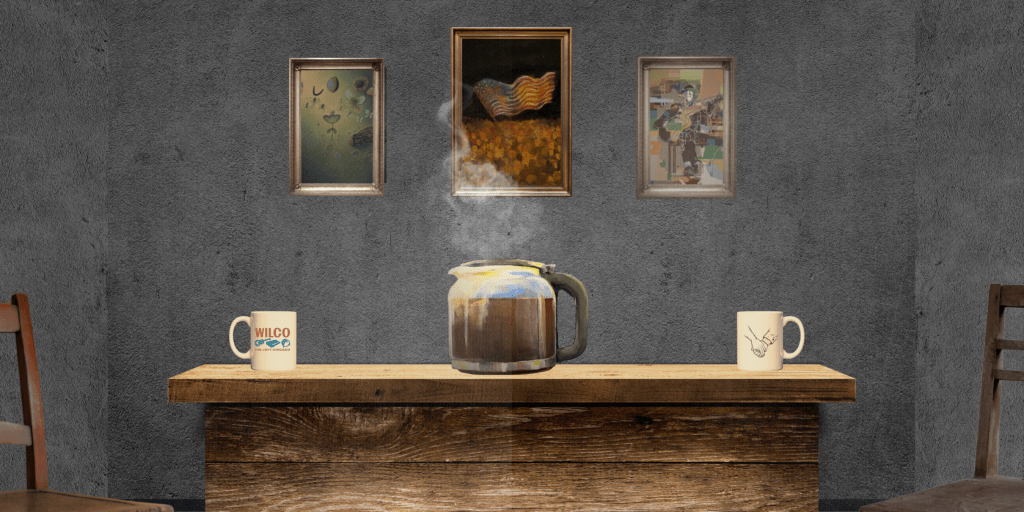
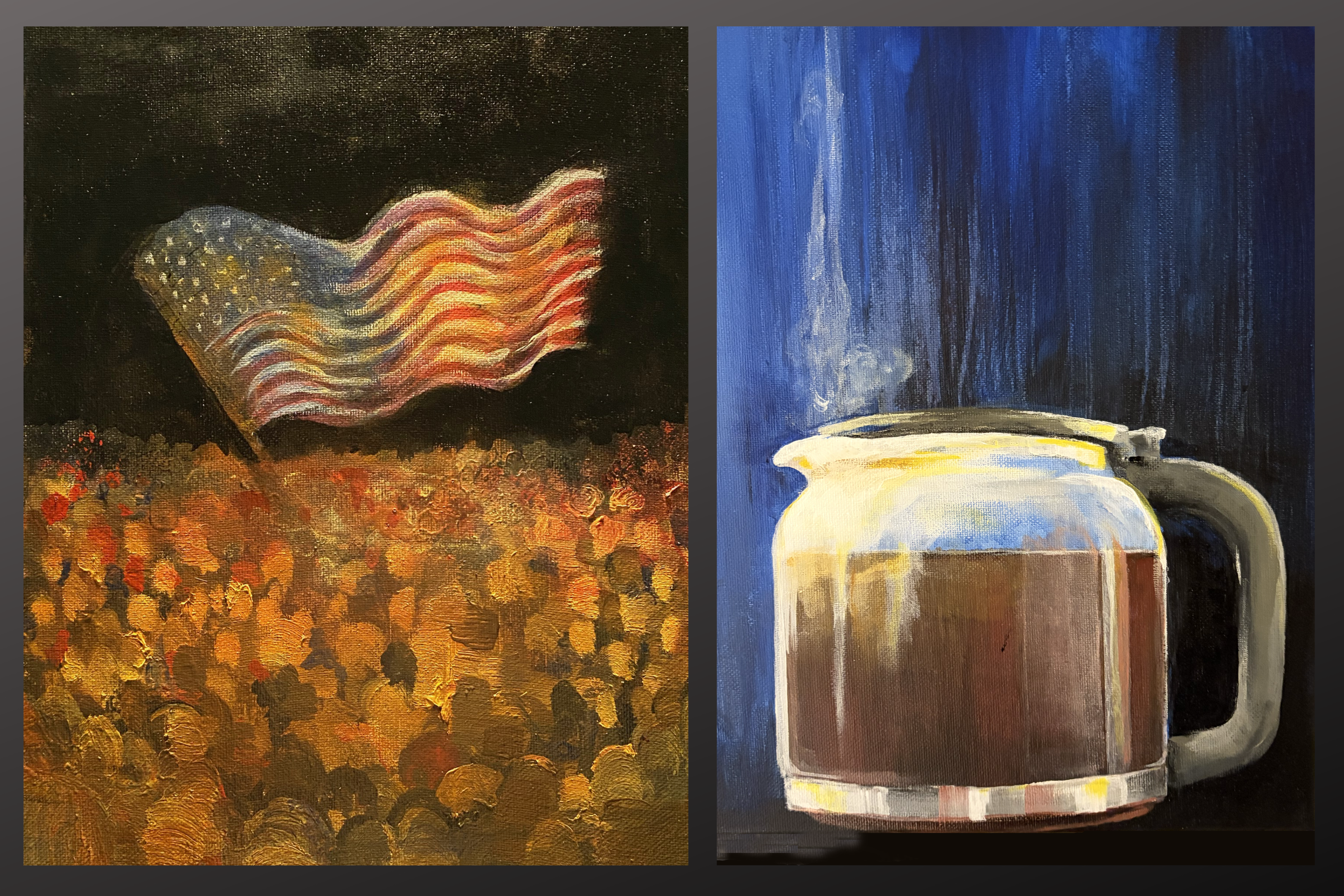
The accompanying digital collage was created using elements from What We Hold On To, incorporating Bonner Fowles’ original cover artwork, with visual references to interior illustrations by Phoebe Shade and Isabelle Luebke, and to the epigraph voices of Jeff Tweedy, Leonard Cohen, and Wendell Berry. It also pays tribute to our first published collection, Record of Dissent.
Cento — Poetry Foundation From the Latin word for “patchwork garment,” a cento is a literary work collaged entirely from other authors’ verses or passages. In their earliest forms, centos were often composed as tribute, such as those by Byzantine empress Eudocia Augusta, which paid homage to Homer. Centos had a resurgence in popularity with the rise of collage as a compositional device among Modernist writers.
Acorns pelt the ground, littering the lawn. She calls them small prophets, warning of the cold to come, though I suspect the trees only speak of the past.
Some numbers are just too big for the human brain to fully comprehend:
a septillion stars, two trillion galaxies, seven billion people, thirty-six percent
of Americans who somehow still look past the casual racism, the xenophobia, the creeping fascism flowing from the sleepy, unhinged man slumped at the Resolute desk.
run long and sit often. what follows will follow. what stays behind was not worth holding.
the demons lose interest when there’s nothing left to feed on, when sweat carries away what words cannot.
the mind, emptied by effort, listens.
there is no trick to this. no door you forgot to open. no shortcut.
only breath, body mind, discipline.
and the sound of your feet on the path,
the slow untying of everything you thought was you.
I guess this should be pretty simple and self-evident, but I’ve noticed over the years that the quality of my mental health is directly tied to the intensity of my physical efforts and the consistency of my meditation. Obviously, there are other components that play a role (for me those other components are meaningful human connection, sobriety, service to others, and creativity) but when I’m at the very least logging lots of long trail runs and staying disciplined in my Vipassana practice, there isn’t much room left for anger or anxiety to hang around.
“You’re sick of the game!” Well, now, that’s a shame. You’re young and you’re brave and you’re bright. “You’ve had a raw deal!” I know — but don’t squeal, Buck up, do your damnedest, and fight. It’s the plugging away that will win you the day, So don’t be a piker, old pard! Just draw on your grit; it’s so easy to quit: It’s the keeping-your-chin-up that’s hard.
—Robert Service
When my sister and I were kids, The Quitter by Robert Service hung on the fridge, held up by a magnet. Our mom made it a rule that we had to memorize the middle stanza. You might think that’s the kind of thing that would annoy a twelve-year-old, and that he’d only come to appreciate it later in life—but honestly, I don’t think that’s the case. I don’t remember it ever feeling like a chore. Who knows. Memory’s a weird thing. But I do know it pretty quickly became one of my favorite poems. I went ahead and memorized the first and third stanzas too, and never forgot them. At 45, I can still recite the whole thing without even thinking about it.
Over the years, the poem became a kind of mantra for me. Whenever things got difficult, that familiar line would pop into my mind like magic: You’re sick of the game? Well now, that’s a shame… It stayed with me through the mess of adolescence, into young adulthood, through basic training, leading an infantry squad in Iraq, getting out and figuring out how to be a civilian, and eventually becoming a parent. Whenever it felt like a decent moment to throw myself a pity party—or maybe even throw in the towel—those lines would show up like an old friend, reminding me to buck up and do my damndest.
The poem hangs on my fridge now. I’m not sure my own kids can recite the middle stanza yet, let alone the whole thing, but someday they will. I feel extremely lucky to have the parents I do. My sister, Meridith, would say the same. They worked hard, expected us to do the same, to pull our weight, and not back down from something just because it was difficult. They’re kind, intelligent, and generous people who have always loved us unconditionally. A lot of the things they did and said have stuck with me, and I’ve tried to carry those lessons and words into my own parenting, though I don’t know if they’ve landed the same way. Time will tell.
Of all the good things they passed down—and there were plenty—The Quitter stands out to me as one of the more memorable wins in the parenting department. Just a printed poem stuck to the fridge, no lecture attached. But the message was clear, and it stayed with me: no matter what life throws at you, even when the chips are down and hope feels out of sight, if you’re still breathing, you can still fight.
And when you fail (because you will), get up, dust yourself off, and give it one more try. It’s the plugging away that wins the day.
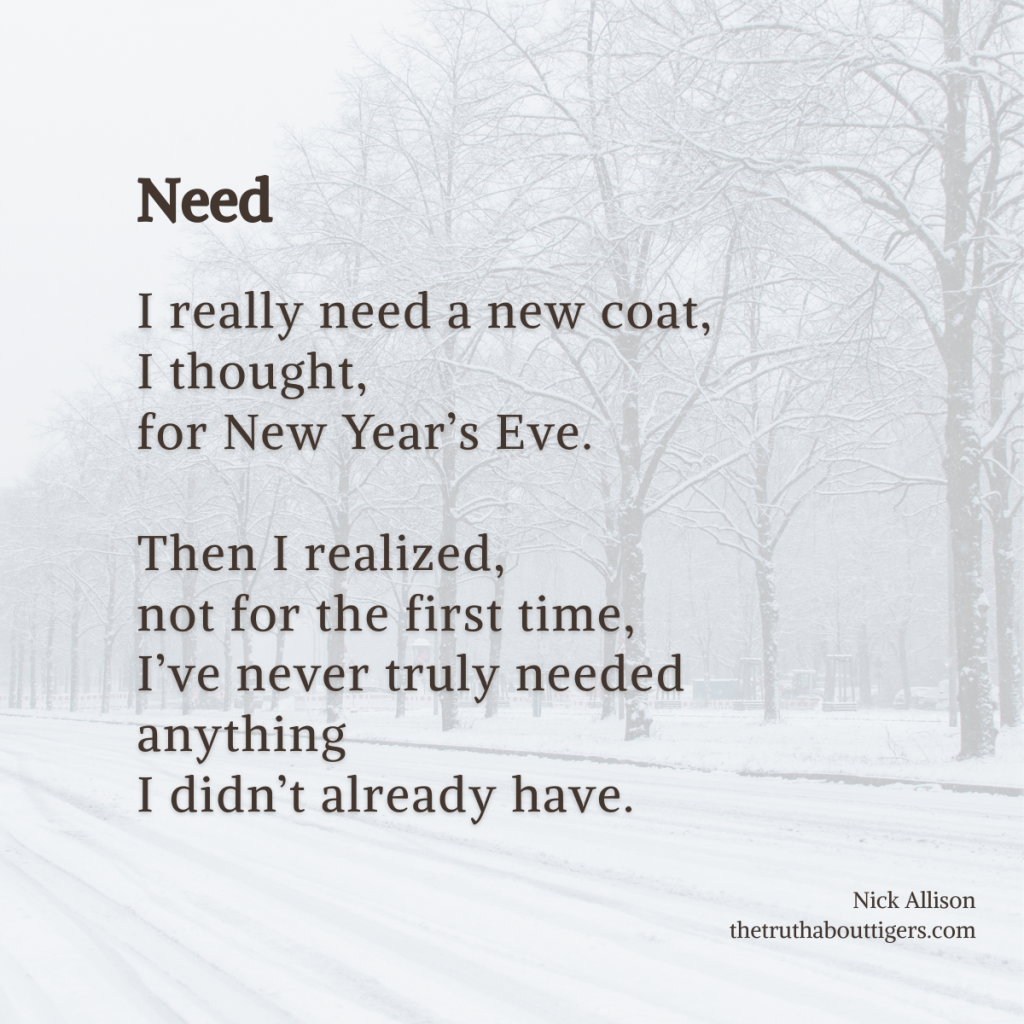
— Nick Allison
If you haven’t read The Quitter in a while—or ever—you should. And it just so happens to be directly below this sentence… isn’t that convenient.
The Quitter
Robert Service
When you’re lost in the Wild, and you’re scared as a child, And Death looks you bang in the eye, And you’re sore as a boil, it’s according to Hoyle To cock your revolver and . . . die. But the Code of a Man says: “Fight all you can,” And self-dissolution is barred. In hunger and woe, oh, it’s easy to blow . . . It’s the hell-served-for-breakfast that’s hard.
“You’re sick of the game!” Well, now, that’s a shame. You’re young and you’re brave and you’re bright. “You’ve had a raw deal!” I know — but don’t squeal, Buck up, do your damnedest, and fight. It’s the plugging away that will win you the day, So don’t be a piker, old pard! Just draw on your grit; it’s so easy to quit: It’s the keeping-your-chin-up that’s hard.
It’s easy to cry that you’re beaten — and die; It’s easy to crawfish and crawl; But to fight and to fight when hope’s out of sight — Why, that’s the best game of them all! And though you come out of each gruelling bout, All broken and beaten and scarred, Just have one more try — it’s dead easy to die, It’s the keeping-on-living that’s hard.
When you spend enough time in a hospital— as a visitor, not a patient— you start to learn a few things.
Like how the coffee costs more at the first-floor café than it does on the second.
But it’s free in the fourth-floor ICU, where there’s an honest-to-God espresso machine. Outpatient surgery on three offers a complimentary pour-over.
And if you befriend the nurses, they might let you slip into the lounge, where snacks and caffeine cost nothing.
You’ll learn other things, too—
Like how, one afternoon in the cafeteria, while drafting a poem you might call A Visitor’s Guide to Free Coffee, a young mother and her son— his head bald from chemo— will walk in.
You’ll watch his face light up over a bowl of cereal and feel ridiculous for thinking about the cost of coffee in a place built to save the most vulnerable.
The boy will beam at his mom, thrilled by the simple gift of Cocoa Puffs. She’ll smile back— brave, bone-tired— and lean in to kiss his pale scalp, her whole world on the edge of crumbling behind those worn-out eyes.
Note: A version of “A Visitor’s Guide to Free Coffee” was first published as a prose poem at Six Sentences — July 2025.
This year, the bluebonnets feel like distractions— a velvet curtain pulled over something beginning to fray.
In the rearview, she hums with Billie Eilish in her headphones, her face still round with youth, but beginning to learn its angles.
I worry. A queer kid in public school, growing up in a state that tilts harder with each new bill.
While those at the top swing hammers at federal protections, local extremists finally see their opening.
She catches me watching. I smile, because she makes me proud— and because that’s the role I’ve been handed: polishing a mask of promise for a future I no longer trust.
Inside, I’m taking notes, tracking exits, wondering how fast the country I once fought for can forget what it promised.
I used to believe in the swing, that the arc bends back, that cruelty burns itself out. Now I’m not so sure. It feels like we’re circling a drain, waving Bibles, burning books, hiding hate beneath the language of—
She laughs at something I can’t hear. The sound slices clean through the noise, bright and real and perfect in a field already fading.
She’s never been one for weighty words, but her expressions shine through with clarity, a language I’ve learned to read across the room.
Her smile sketches the degrees of joy, her shoulders measure the weight of weariness, her touch—a whisper of empathy. And her eyes—eyes that reflect all the ways blue can be— mirror shifting moods, fleeting thoughts, the quiet undercurrents of her heart.
A brief window into the storms and still waters within.
The yew leans into her thousand years, while the moon moth burns swiftly through a handful of days. Eight decades feel fair, if spent well, we tell ourselves.
Antares yawns across another eon and winks at Sirius, grown weary of our fragile math and wistful speculation.
So, it turns out that yesterday, December 4th, was International Cheetah Day. Who knew? I missed it, regretfully, lost in the blur of a day that dashed by.
Had I known, what would I have done to celebrate? Maybe made a modest donation to the Cheetah Conservation Fund? Or perhaps something bolder, more intriguing.
I could have strolled casually to the zoo and gazed at these spotted sprinters, lazing in poor approximations of vast savannahs, worlds away from their wild grasslands. No longer fierce hunters, but prisoners awaiting meals delivered at regular intervals through cell doors.
Suddenly, one would approach the glass, and, glancing around for guards, I’d lean in close to share a whispered plot, a moonlit jailbreak. His ears might twitch with a spark of hope, our eyes locked in covert complicity, as I outline our daring midnight escape. For a fleeting moment, he’d be captivated, tail flickering with the thrill of a real run.
But then, with wisdom in his gaze, he would silently decline. Understanding the odds, the reality – quickly captured again, certainly sent to solitary, if not shot on sight in the urban jungle.
I would nod, sadly, place my fist against the glass, and he, with a furry paw, would do the same, a gesture of solidarity. Then, I’d slowly walk away, a conspirator without a cause, wishing to offer more than fanciful thoughts, and desperate daydreams, on this day dedicated to his species.
This poem was originally published in Kindred Characters, the debut issue of Lark and Owl Booksellers’ literary journal.
In my mind, I have more hair than I do on my head. The mirror in the living room whispers a reminder, showing me someone older than the faded photograph tucked away in my mind.
Across the room, young Dylan leans from his frame, guitar slung low, curls tumbling like a reckless thought, untouched by whatever it is that holds us all in place.
When we saw him in Austin, I watched him fidget with his hair, patting it back into place— which, at 83, remains thicker than mine.
But the mirror also catches the TV screen, swing state results scrolling like distant thunder, reminding me there are bigger storms brewing
than these quiet, inevitable losses I’ve just now managed to nearly forget.