This poem first appeared in The Awakenings Review, Spring 2026, Volume 13, Number 1.
There was a time, a million years ago, when I believed art held some unique truth— a breath beneath color.
I angled paintbrushes toward the sky like telescopes, searched headlines through a camera lens, stood invisible on street corners with a ghost-hungry journal.
But then winter arrived and I called off the search—abrupt. Like the last shot fired in a clean, well-lighted place.
What truths can you find in five short years of stick-figure drawings and sloppy finger paint?
After I dropped the last shovel, I briefly dug for meaning beneath desert dogma, but the ground split too wide for a mind broken but still skeptical— too stubborn for feel-good bullshit or vague deity threats.
Once, I took a poetry class with a teacher who meant well. She was kind. Talented. But when she said, To be a good writer, you sit at the computer and bleed, my eyes rolled so far back I saw the past.
Me—alone in a room of books, loving Hemingway the most.
If you’re going to modernize a stolen quote, at least credit the dead man who suffered it first.
Not that I’m above theft. For a decade, I wore a borrowed smile, stretched over my face like cheap fabric, just to dodge that empty concern, Are you okay?— a dumb question with an easy answer I learned the old-fashioned way.
Eventually, the smile became my own. And maybe there was truth to be found somewhere— but I’m not going to tell you about that.
Because even if clichés sometimes crack open the dark, you wouldn’t want to see them here.
The Awakenings Review is a literary journal published by The Awakenings Project, an organization founded to support the artistic work of people with a lived experience of mental illness. Established in 2000 with support from the University of Chicago Center for Psychiatric Rehabilitation, the journal publishes poetry, fiction, and art by writers and poets who have a personal relationship to mental illness, whether their own, a family member’s, or a friend’s. It is one of the few literary journals in the country exclusively committed to this community, and received Mental Health America’s 2024 Media Award.
Five of my poems appear in the Spring 2026 issue, Volume 13, Number 1. The journal is print only, but I’m sharing them here. If this kind of work matters to you, it’s worth supporting. You can find them at awakeningsproject.org
Quiet Compliance
The mask becomes your face— a shell you never meant to keep, carved to coax a voice out of the natural quiet that was always yours.
In small, obedient gestures you built your own confinement, grasping for the thing that kills, just to vanish a while longer.
There’s a kind of magic in it— to disappear in plain sight, to fold yourself beneath the weight of expectation—
while the machine cranks out billion-dollar death campaigns disguised as joy, as rebellion, as belonging.
To adapt to illness, to bury the self in the haze, all for the familiar delusion—
Look at us! Soul-split specters, clinging— pleading for the dose.
Normal is a fragile, strangest fiction.
Measuring the Distance
Each morning, a slight revision, colored by thoughts and opinions— both mine and the ones I’ve borrowed.
The mirror doesn’t argue. It only offers today’s version of me.
Somewhere, in the silver hush of reflection, a stranger lifts my hands, measures the distance— who I am, who I almost was.
Choices aren’t made—only followed. A series of events, disguised as free will— the past bends into the shape of my body, a path unfolding just as I arrive.
Perhaps I’ve always been walking backward, mistaking repetition for progress.
A shift in light. A warping of glass.
No one ever steps fully into focus.
what follows will follow
run long and sit often. what follows will follow. what stays behind was not worth holding.
the demons lose interest when there’s nothing left to feed on, when sweat carries away what words cannot.
the mind, emptied by effort, listens.
there is no trick to this. no door you forgot to open. no shortcut.
only breath, body mind, discipline.
and the sound of your feet on the path,
the slow untying of everything you thought was you.
I Loved Hemingway the Most
There was a time, a million years ago, when I believed art held some unique truth— a breath beneath color.
I angled paintbrushes toward the sky like telescopes, searched headlines through a camera lens, stood invisible on street corners with a ghost-hungry journal.
But then winter arrived and I called off the search—abrupt. Like the last shot fired in a clean, well-lighted place.
What truths can you find in five short years of stick-figure drawings and sloppy finger paint?
After I dropped the last shovel, I briefly dug for meaning beneath desert dogma, but the ground split too wide for a mind broken but still skeptical— too stubborn for feel-good bullshit or vague deity threats.
Once, I took a poetry class with a teacher who meant well. She was kind. Talented. But when she said, To be a good writer, you sit at the computer and bleed, my eyes rolled so far back I saw the past.
Me—alone in a room of books, loving Hemingway the most.
If you’re going to modernize a stolen quote, at least credit the dead man who suffered it first.
Not that I’m above theft. For a decade, I wore a borrowed smile, stretched over my face like cheap fabric, just to dodge that empty concern, Are you okay?— a dumb question with an easy answer I learned the old-fashioned way.
Eventually, the smile became my own. And maybe there was truth to be found somewhere— but I’m not going to tell you about that.
Because even if clichés sometimes crack open the dark, you wouldn’t want to see them here.
If I Let Myself Go
If I let myself go— not just falter, but fall— I lose the trail back from the sorrow of strangers, absorb the newsprint weight of grief until it settles in my marrow like winter.
The lines drawn in blood blur easily— becoming this mother, and the father across the river.
To feel what the world keeps behind glass is to glimpse something unspoken, something real.
Not evil, exactly. Maybe wrongness. A hollow in the hive-mind where reason should live— the inheritance of lazy thinking and sun-faded flags.
This old game? Yes, we’re still playing, though no one remembers to keep the score.
And I can choose to carry the cost, or set it down— to look away, like we do with so much else.
For now, I’ll stay a while—keep vigil in that hollow room built for one, but known by all, eventually.
I suppose I owe at least a breath of attention, the small price of saltwater and silence— to follow the trail, step into the slow-dark hush of grief that isn’t mine—
I probably lied to her when she asked about the future of her world— what else can you do when a young child pictures fields of fire, fueled by the fossils we burn, hands clutching rifles tighter than reason, the quiet neglect of those left shivering on street corners?
I see the same— though I wish I didn’t. So instead, I whispered of hope— hope in her generation, better than ours, believing they can mend the mess we leave behind.
A parent never wants to see fear reflected in their child’s eyes— or worse, the slow dimming of belief that things will get better.
What I don’t see— not yet at least— is disappointment. But it will come, with age and understanding, with eyes that once gazed hopefully at the future, now looking back to me for answers—
because I am the goddamn adult here, and I should know how to fix everything.
I was up before the squirrels this morning, before the sun, too. On the front porch, all is quiet, the way early mornings tend to be.
In cupped hands I catch a moment that refuses to be counted, steady enough to cradle, gentle enough to release what isn’t mine to keep.
A butterfly teases a northwest breeze, a tethered promise of flannel and fleece. Its wings catch the first light, red softening to orange, black to something more than gray.
I think again about numbers— about days, months, years— each lived alone, each carrying its own weight, boxed inside borders we draw.
From a distance they slip into a current, slow at first, then less so.
The first squirrel gives in to gravity, drops, gathers acorns meant for the earth, then retreats into late-summer leaves, off to do whatever squirrels do.
This poem was first published at MasticadoresUSA. Thanks you, Barbara!
Hi, friends. I wanted to share a few Collaborature updates in one place. Editor Melissa Lemay featured Mad Dark Winter Sky, a short poem my daughter Phoebe and I wrote together a few years ago when she was nine. We made it using those little word magnets you can rearrange on the refrigerator to form sentences.
Melissa also invited me to serve as the guest judge for the November contest—something I was admittedly nervous about and felt under-qualified for. But, being the wonderful human she is, Melissa put me at ease and reminded me that the guest judge simply chooses the poem that resonates most. In the end, I went with the one that jumped out to me first and stayed with me the longest. Congratulations to Chiwenite Onyekwelu for the winning poem, The Carpenter at St. Ignatius. There’s also a brief “meet the judge” introduction if you’re interested.
Collaborature is a collaborative literary space built around honesty, creativity, and community, and it’s well worth checking out.
The mask becomes your face— a shell you never meant to keep, carved to coax a voice out of the natural quiet that was always yours.
In small, obedient gestures you built your own confinement, grasping for the thing that kills, just to vanish a while longer.
There’s a kind of magic in it— to disappear in plain sight, to fold yourself beneath the weight of expectation—
while the machine cranks out billion-dollar death campaigns disguised as joy, as rebellion, as belonging.
To adapt to illness, to bury the self in the haze, all for the familiar delusion—
Look at us! Soul-split specters, clinging— pleading for the dose.
Normal is a fragile, strangest fiction.
I wrote this poem a few years ago. I honestly can’t remember if it was while I was still drinking or in the foggy stretch right after I quit.
I don’t have an exciting story to tell you about high-speed police chases, or cars full of “hookers and blow,” or waking up in the hospital, or some other cinematic rock-bottom meltdown. I didn’t drink before work. I didn’t drink at work. I didn’t lose my job or my family or my driver’s license. The reality was simpler. Boring, even.
It goes something like this: For years I drank normally. With friends. At bars or parties. A couple beers at a barbecue. Then, slowly, I started drinking more. And more. Then every single night, often to the point of partial blackout. Alcohol stopped being a social thing and became the way I smothered emotions and turned down the volume on problems I didn’t want to face.
There were plenty of mornings where I’d stare at my bloodshot eyes and puffy face in the bathroom mirror at 5 a.m., getting ready for work after another random Tuesday night where I’d polished off an entire 750 ml bottle of bourbon or vodka while watching TV, and mutter out loud to myself, “What the fuck is wrong with you?” You know, the kind of things “normal” people do.
Reality was puking into a toilet at midnight because I’d overdone it again and only had a few hours before my alarm went off. Reality was planning how to work booze into every event. Reality was going to the kitchen to “grab more ice” when really I needed to do a private shot because everyone else was drinking too slowly.
And while I wasn’t a mean drunk or a violent drunk, I definitely wasn’t as present with my family as I should have been. As I am now. There’s just no way—I spent too much time thinking about drinking, doing the drinking, or recovering from the drinking. Being a drunk is basically a full-time job made of guilt and logistics.
Then one morning, after what counted as a “light” night (splitting a six-pack with a friend and chasing it with a couple vodkas on the rocks, because let’s be honest, three beers might as well be water at that point), I went to bed and told myself, You know what, I think I’m done.
I didn’t believe it. Not really. It certainly wasn’t the first time.
I’d stopped plenty of times—or paused, technically. A week here. A month there. Once I even went five months without a drink before my brain convinced me that if I could stop for almost half a year, I didn’t actually have a problem and could definitely “moderate” going forward.
You already know how that story ends.
But for whatever reason, this time—March 2, 2023—something was different. I think a big part of it was the language I used with myself. Instead of I’m taking a break or I’m not drinking right now, I started saying, I quit drinking. Or, No thanks, I don’t drink.
Saying it out loud felt terrifying at first—like the words themselves were pushing me closer to some irreversible finish line I wasn’t fully convinced I wanted to cross—but it also started rewiring something.
The funny part is I didn’t get much encouragement. Mostly because I was “good” at drinking. Or maybe just good at hiding how much I drank. I’ve seen videos of myself on nights when I know for a fact I was absolutely shitfaced but not tripping or yelling or slurring my words. A “high tolerance” isn’t always a good thing. The most common response I got when I told someone I quit was some version of, “Why?” People I cared about genuinely had no idea what was going on in my head.
But I had one friend—one of my best friends of forty years, who quit a couple years before me—who understood immediately. He didn’t preach or brag or try to turn it into a competition. He just listened. Said he was proud of me. Told me he’d be there if I ever needed to talk. And for the first time—at least when it came to drinking—I felt, as the kids say, “seen.” (Do the kids still say that?)
I’m not going to go into detail about how I quit, because that part is different for everyone. There’s no single method. For me, it was a mix of books, podcasts, trail running, meditation, support from a few key friends, reinvesting in some meaningful relationships, walking away from a few unhealthy ones, and constantly reminding myself that I get to choose my own future.
That’s not the entire story, but it’s good enough for now.
Today, the day before Thanksgiving, marks 1,000 days sober. I know that’s not monumental in the grand scheme—not even three years—but something about hitting quadruple digits feels like a milestone worth acknowledging. Maybe even worth celebrating.
And that celebration is going to be simple: a long run, a nice dinner with family, and a Thanksgiving morning without a hangover. Which is something I can be genuinely grateful for.
run long and sit often. what follows will follow. what stays behind was not worth holding.
the demons lose interest when there’s nothing left to feed on, when sweat carries away what words cannot.
the mind, emptied by effort, listens.
there is no trick to this. no door you forgot to open. no shortcut.
only breath, body mind, discipline.
and the sound of your feet on the path,
the slow untying of everything you thought was you.
I guess this should be pretty simple and self-evident, but I’ve noticed over the years that the quality of my mental health is directly tied to the intensity of my physical efforts and the consistency of my meditation. Obviously, there are other components that play a role (for me those other components are meaningful human connection, sobriety, service to others, and creativity) but when I’m at the very least logging lots of long trail runs and staying disciplined in my Vipassana practice, there isn’t much room left for anger or anxiety to hang around.
When you spend enough time in a hospital— as a visitor, not a patient— you start to learn a few things.
Like how the coffee costs more at the first-floor café than it does on the second.
But it’s free in the fourth-floor ICU, where there’s an honest-to-God espresso machine. Outpatient surgery on three offers a complimentary pour-over.
And if you befriend the nurses, they might let you slip into the lounge, where snacks and caffeine cost nothing.
You’ll learn other things, too—
Like how, one afternoon in the cafeteria, while drafting a poem you might call A Visitor’s Guide to Free Coffee, a young mother and her son— his head bald from chemo— will walk in.
You’ll watch his face light up over a bowl of cereal and feel ridiculous for thinking about the cost of coffee in a place built to save the most vulnerable.
The boy will beam at his mom, thrilled by the simple gift of Cocoa Puffs. She’ll smile back— brave, bone-tired— and lean in to kiss his pale scalp, her whole world on the edge of crumbling behind those worn-out eyes.
Note: A version of “A Visitor’s Guide to Free Coffee” was first published as a prose poem at Six Sentences — July 2025.
This year, the bluebonnets feel like distractions— a velvet curtain pulled over something beginning to fray.
In the rearview, she hums with Billie Eilish in her headphones, her face still round with youth, but beginning to learn its angles.
I worry. A queer kid in public school, growing up in a state that tilts harder with each new bill.
While those at the top swing hammers at federal protections, local extremists finally see their opening.
She catches me watching. I smile, because she makes me proud— and because that’s the role I’ve been handed: polishing a mask of promise for a future I no longer trust.
Inside, I’m taking notes, tracking exits, wondering how fast the country I once fought for can forget what it promised.
I used to believe in the swing, that the arc bends back, that cruelty burns itself out. Now I’m not so sure. It feels like we’re circling a drain, waving Bibles, burning books, hiding hate beneath the language of—
She laughs at something I can’t hear. The sound slices clean through the noise, bright and real and perfect in a field already fading.
Hi, friends! I haven’t posted much lately because I’ve been busy editing a poetry chapbook that just dropped a few days ago: Record of Dissent: Poems of Protest in an Authoritarian Age. You can read or download the full collection over at The Chaos Section Poetry Project.
This poem didn’t make it into the chapbook, but it’s cut from the same cloth. I wrote it a few months ago, driving back into the Texas Hill Country with my daughter after visiting family in New Mexico. We traversed the Edwards Plateau, then dropped into the Hill Country, where Austin sprawled ahead. The bluebonnets were blooming and the fields were beautiful, but my mind was elsewhere.
I’d just read an article about anti-LGBTQ legislation targeting public schools here in Texas—can’t even remember which bill, honestly. Around that same time, I saw another headline about the Trump administration’s proposed budget cuts that would eliminate funding for the LGBTQ youth suicide prevention hotline. I ended up writing an essay about those cuts, which ran in HuffPost. You can read it here if you’re interested.
Fluffy pink unicorns dance on rainbows while long-lashed dogs wear flowers like fur. Soft green Yoda-lights sway overhead, framing my second-story window where moonlight spills onto the bed, silver-casting quiet shadows.
I drift, carried across a calm sea of sleep.
At dawn, I wake in a brighter room— its sharp light hums like a secret. A blue shark swims across a storm-tossed whiteboard before the bed floats gently down a river of tile.
Magic doors open, a deep breath, and then—nothing. Quieter than dreams, deeper than memory.
When I surface again, the curtains sway, soft as whispers, their patterns slip through the mind-haze. Family waits, voices steady, smiling as I slowly return to my body.
A kind nurse guides me to the chair. Its wheels sing toward the elevator, to the car, and then,
Home.
Whole again, though I never truly fell apart.
Note: This poem was first published in Issue 3 of Poems for Tomorrow, a poetry and art journal that shares creative work with patients in hospitals and care facilities. Their mission is simple and good: to help people feel connected, loved, and heard during hard moments. They put together anthologies of poems and art that are placed in hospital waiting rooms, senior centers, and long-term care units—places where a little beauty can go a long way.
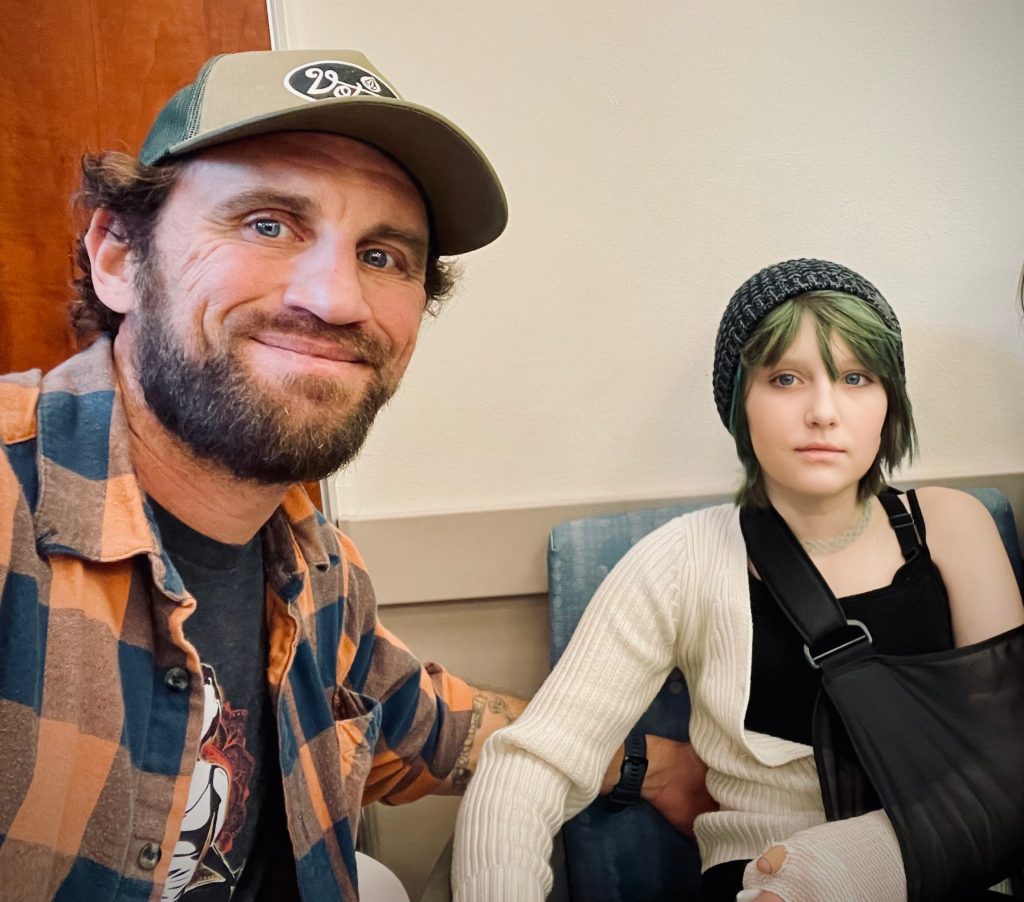
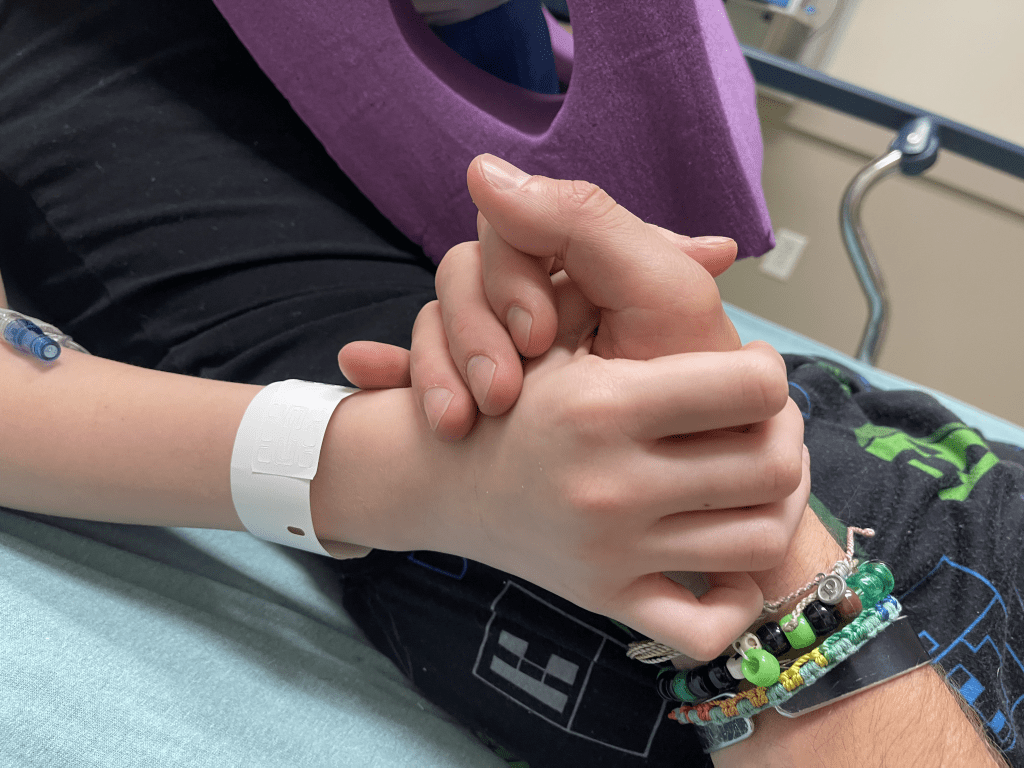
“Magic Doors” is a chain poem co-written, line for line, with my 11-year-old daughter, Phoebe, during the days surrounding her surgery to repair a severe double fracture in her left forearm. Both the radius and ulna were shattered, and the repair required rods and a full-arm cast. The poem tells her story through the eyes of three rooms: her bedroom the night before, the pre-op room, and the recovery room. It’s about resilience, imagination, and the strange kind of magic that shows up when you’re stuck in a hospital and still trying to feel like yourself. She’s an amazing, kind, empathetic, and creative kid, and I couldn’t be more proud of her.
They also published Phoebe’s original painting, Stargazing Cat on a Beach at Midnight—an acrylic-on-canvas piece she made for her grandfather while he was in the hospital recovering from throat cancer surgery.
The yew leans into her thousand years, while the moon moth burns swiftly through a handful of days. Eight decades feel fair, if spent well, we tell ourselves.
Antares yawns across another eon and winks at Sirius, grown weary of our fragile math and wistful speculation.
Another New Year’s Eve has arrived. The weather couldn’t have been better—65 degrees and sunny, with a light north wind. I spent the day visiting the Austin Zen Center, taking a walk along Lady Bird Lake, and enjoying a cup of coffee at Civil Goat on Guadalupe, where I wrote this short poem.
Thank you to everyone who has taken the time to read or comment this past year—and even more so, thank you for all the incredible poetry you’ve shared. Y’all are the best. It’s awesome to have a group of such talented, inspiring friends—that I’ve never actually met.
Wishing you all a safe, happy, and peaceful new year.
– Nick
Make Friends with the Fallen Leaves
A quiet door opens, as another closes. The last breath of the year feels much like the first.
This next revolution greeted with mindful gratitude, an earth-bound walk. When feet brush the path, it sounds like surrender.
A song shared with a winter bird, a nod passed to a stranger— just for a moment, before momentum carries forward.
We smile, pay our respects to impermanence. And make friends with the fallen leaves.
You come from survivors. That is plain in the fact that you are here.
Someone before you walked through a winter without enough bread. Someone slept in a field while artillery stitched the earth. Someone buried a child and still rose at dawn to tend the living.
Their hands were cracked. Their teeth broken. Their backs bent under work or war that did not care who they were.
And still— they kept breathing.
Now you stand in your own weather, heart unsteady, the ground uncertain beneath your feet.
But the breath that kept them standing moves through you— has always moved through you.
It isn’t like you said the actual words, But I caught your drift just the same. And while I may not prance joyfully Down the promenade in agreement,
I can’t dispute your point. I wonder, If Gray, in seventeen forty-two, with tomes Of Seneca beside, his thoughts adrift In Stoic seas—did he find bliss in nescience?
One can hear the old philosopher, speaking to Lucilius, Of the burden and balm of knowing, The impossibility of living—a truly happy life, Or even one bearable—beneath the veil of naivety.
When Gray penned his oft-misquoted ode, Did he whisper of the folly in our wisdom, The unseen chains it casts upon the mind?
Of course, if I’d never danced through those pages, I wouldn’t be here, struggling to weave these thoughts into questions and answers in the first place.
Each connected, all impermanent. But you already know this, because it was you who first spoke to me about the waves and the ocean and the clouds to begin with.
Crest and fall, rejoin, never having left, nothing to abandon, just a lofty stretch and a return to the essence, as the gulls of curious thought feather-paint the drifting mist.
A sun-warmed sigh, drawing it all back home, belonging to ourselves and to no-thing, while the deep-swimming monsters sometimes breach the surface,
and utter their deep calls of mischief, their lidless eyes, reflecting all the light we cast, a delicate dance between flame and shadow — they are also us.
Where whispers of waves soothe the shore, we find solace in the cycle, the delicate flow of being and becoming in this shared journey, connected, accepting the transient nature of all.
But of course, you already understand all of this, because you were the one who first showed it to me, when I was still paddling alone against the illusion of separateness.
This poem, The Illusion of Separateness, was first published by Masticadores USA on April 26th, 2024. I am grateful to the editors for featuring my work.
Gone are the friendly policy disagreements of my youth, replaced by vitriolic division, my side is right and fuck you if you disagree.
Does time move faster as you age? Each four-year cycle shrinks to months, the campaign season never really ends.
The latest outrages, two tumultuous extremes— a line that is a circle, meeting at the fringe. Perhaps it’s time to batten the hatches,
and let this latest tempest pass— surely it will pass, right? This insanity, is it the new normal, this endless fight?
Threatening to drag the whole goddamn system down, into the gutter of failed empires, as politics and relentless news cycles turn neighbors and friends into mortal enemies.